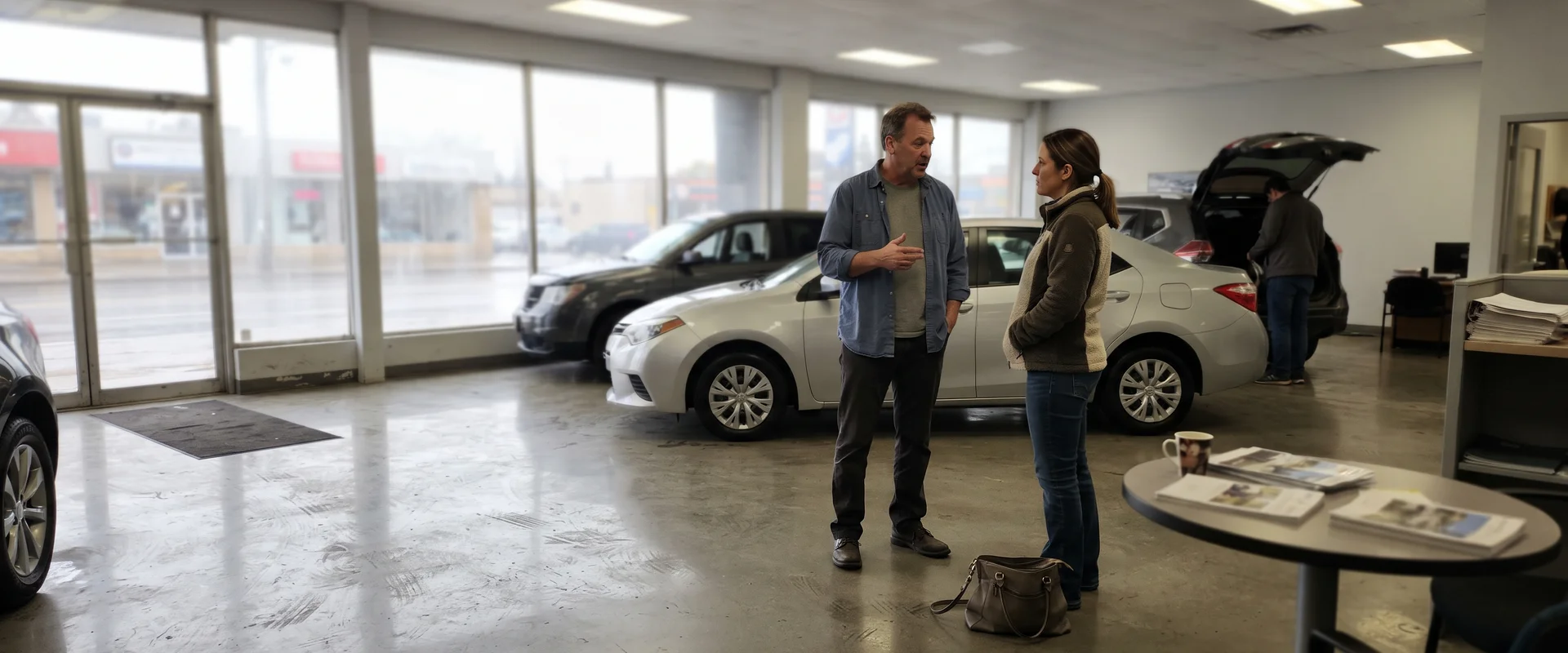
Auto showroom with a high-gloss polished concrete floor reflecting overhead lighting

Polished Retail & Auto-Showroom Concrete Floors in the GTA

Polished commercial finishes for auto showrooms, retail floors and offices.

  • verified 2-Year Workmanship Warranty
  • shield WSIB + $2M Liability
  • schedule 2-Hour Quote Window
  • star 4.9 Google Rating
Published pricing $5 - $10 per sq ft
  • 4.9 Star Google Rating
  • Published Pricing
  • 2-Year Workmanship Warranty
  • WSIB + $2M Liability
  • 2-Hour Response Window
  • 24/7 Phone
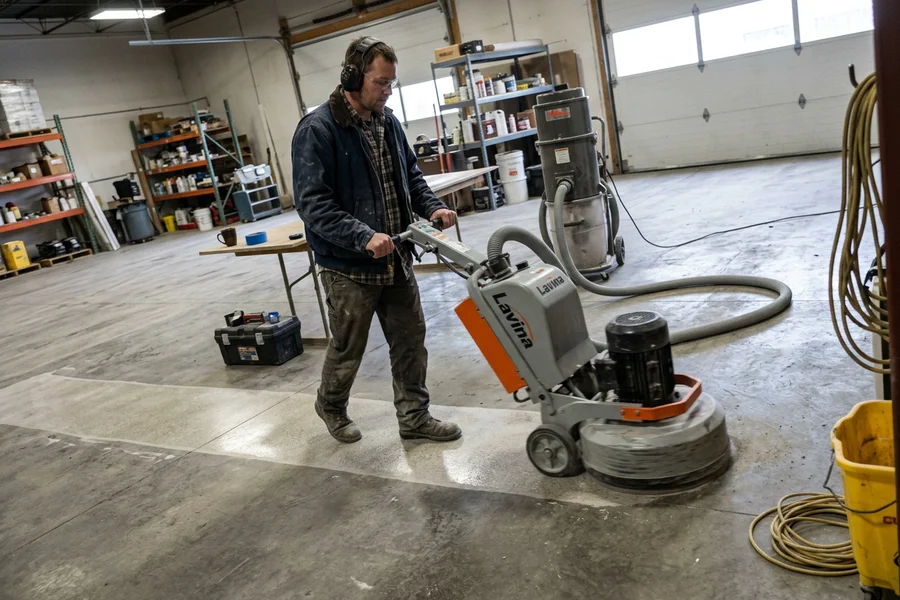
Operator running a planetary floor grinder with the polished strip beside unfinished concrete

What Is a Polished Retail or Showroom Floor?

Polished concrete is not a coating. There is nothing applied on top that can peel, chip or delaminate. The floor you walk on is the concrete slab itself, ground progressively finer with diamond tooling, chemically hardened with a lithium-silicate densifier, and burnished until it reflects light.

That distinction is why it dominates auto showrooms, larger retail units and modern offices. A coating has a service life and a failure mode. A polished slab is the structure, and the maintenance programme is dust mopping and clean water.

The process runs in sequence. Metal-bond diamonds cut through the surface paste to the exposure level you have chosen. The densifier soaks in and reacts with free lime in the concrete to create a harder, denser surface. Then progressively finer resin pads polish that hardened surface, up to 1,500 grit for a full mirror. An optional guard coat adds stain resistance in food and beverage areas.

Every grinder runs on dust extraction. Retail and showroom work almost always happens next to occupied space, and dust is not something a tenant will tolerate.

What’s Included

  • Slab hardness and flatness assessment
  • Removal of adhesive, thinset or existing coatings
  • Progressive metal-bond diamond grinding with extraction
  • Crack and joint filling with colour-matched semi-rigid filler
  • Lithium-silicate densification
  • Resin pad polishing to the agreed gloss level
  • Optional penetrating dye for even colour
  • Optional guard coat for stain resistance
  • Final burnish and hand-back

Common Problems We Solve

Dated Vinyl and Tile

Pulling up worn vinyl or ceramic and polishing what is underneath removes a recurring replacement cost from the building’s budget. Adhesive removal is part of the grinding sequence, and heavily glued floors simply take more passes.

Uneven Colour Across a Large Floor

Concrete placed on different days, or patched over the years, rarely tones evenly. A penetrating dye applied mid-sequence unifies the colour without creating a film, so the result reads as one floor rather than a patchwork.

Dusting and Scuffing

Untreated commercial slabs shed fine dust and scuff under trolley and foot traffic. Densification hardens the surface enough that both problems stop, even at a modest satin gloss level.

Poor Light Levels

A high-gloss floor bounces overhead lighting back into the space. In showrooms and larger retail units that measurably reduces the lighting load, which is a real operating cost saving alongside the visual effect.

How Much Do Polished Floors Cost in Toronto?

Polished commercial floors run $5 to $10 per square foot. Drivers:

  • Gloss target. Satin needs fewer passes than a 1,500-grit mirror.
  • Slab condition. Soft, patched or heavily glued slabs take more preparation.
  • Aggregate exposure. Cutting deeper to expose stone means more metal-bond passes.
  • Colour. Penetrating dye adds material and labour.
  • Crack filling. Extensive crack repair before polishing is quoted separately.
  • Access window. Overnight and phased work carries a premium against lost trading.

Types of Polished Finish

Cream finish grinds only the surface paste, showing almost no aggregate, and gives the most uniform appearance. Salt-and-pepper exposes fine aggregate and is the most common showroom choice. Full aggregate exposure cuts deep enough to reveal the larger stone, producing a terrazzo-like look that depends entirely on what is in your slab. We always cut a test patch before committing the main floor, because aggregate is not visible until you go looking for it.

Gloss is a separate axis: matte, satin, semi-gloss and high gloss are achieved through the resin pad sequence and burnishing, and can be verified with a gloss reflectometer where the specification requires it.

When Does Polishing Not Make Sense?

If the slab is soft, badly cracked across most of its area, or riddled with patches of different materials, polishing will show all of it. In that case an overlay or a coating is a more honest recommendation, and we will say so. Polished concrete reveals what is in the floor rather than covering it, which is exactly why it looks the way it does when the slab is good.

Send us the floor area, current finish and trading hours and we will come back with a written published-rate quote inside two hours.
Published pricing

How Much Does Showroom Floors Cost in Toronto?

$5 - $10 per sq ft

Satin Gloss

$5 - $6.50 / sq ft

  • Grind through medium grit sequence
  • Lithium-silicate densifier
  • Satin sheen finish
  • Ideal for offices and back-of-house
Get a Free Quote
Most requested

Semi-Gloss Showroom

$6.50 - $8 / sq ft

  • Everything in satin gloss
  • Extended resin pad sequence
  • Optional dye for even tone
  • Guard coat for stain resistance
Get a Free Quote

High Gloss

$8 - $10 / sq ft

  • Everything in semi-gloss
  • Full sequence to 1,500 grit
  • Burnished mirror finish
  • Gloss level verified with a reflectometer
Get a Free Quote

Rate depends on the number of grinding passes, the target gloss level, the condition of the existing slab, and whether dyes or a guard coat are included.

Rates are published up front with no hidden fees. Final pricing depends on site conditions, thickness, reinforcement, and finish. See the full published rate card.

Why choose us

Why Choose Best Concrete Toronto for Showroom Floors?

Gloss You Specify

Satin, semi-gloss or full 1,500-grit mirror. We agree the target up front and can verify it with a reflectometer.

Dust Controlled

Every grinder runs on extraction. Retail and office work happens next to occupied space, and dust is not acceptable.

Low Lifetime Cost

No coating to peel, no vinyl to replace, no waxing programme. Polished concrete is cleaned with water and re-burnished occasionally.

Scheduled Around Trading

Overnight and weekend windows so a store or dealership can keep trading through the work.

Our process

How Does Showroom Floors Work?

  1. 1

    Slab Assessment

    We check hardness, flatness and aggregate depth to set realistic expectations for exposure and gloss.

  2. 2

    Written Quote

    Published per-square-foot pricing in writing inside our 2-hour response window.

  3. 3

    Grind & Densify

    Progressive diamond tooling with dust extraction, then lithium-silicate densifier to harden the surface.

  4. 4

    Polish & Protect

    Resin pad sequence to the target gloss, optional guard coat, then burnish and hand back.

Our work

Showroom Floors Projects Across the GTA

Click any image to enlarge.

How Best Concrete Toronto Compares

Factor Typical Contractor Best Concrete Toronto
Gloss control Whatever grit sequence the crew defaults to Gloss target agreed up front, verified with a reflectometer
Quote turnaround 2 to 5 business days 2-hour response window
Dust control Open grinding, dust into occupied space Every grinder runs on extraction
Scheduling Store closed for the work Overnight and weekend windows to keep trading
Expectation setting Promises full aggregate exposure regardless of the slab Test patch cut before committing the main floor
Testimonials

What Customers Say About Our Showroom Floors Work

4.9 out of 5 across Google reviews

"Dust was kept to a minimum and they finished in the days they promised. The floor transformed the space."
Kevin M. Toronto
"Consistent gloss across a large open area, which is harder than it looks. Reflects the lighting beautifully."
James T. Mississauga
"They set expectations honestly about how much aggregate would show. No surprises when the floor came up."
Grace L. Cornell
Common questions

Showroom Floors FAQs

How much do polished showroom floors cost in Toronto?

Polished commercial floors run $5 to $10 per sq ft depending on the number of grinding passes, target gloss, slab condition and whether dyes or a guard coat are included. Large open areas sit at the lower end.

Can any concrete slab be polished?

Most can, but the result varies. A hard, dense slab polishes to a high gloss. A soft or heavily patched slab may need a densifier earlier in the sequence or may only reach a satin sheen. We test hardness before quoting so the expectation matches what the floor can deliver.

How much aggregate will show?

That depends on how deep we grind. A cream finish grinds only the surface paste and shows almost no stone. A salt-and-pepper finish shows fine aggregate. A full aggregate exposure shows the larger stone. We agree the target on a test patch before the main floor starts.

Is polished concrete slippery?

Less than most people expect. Clean, dry polished concrete has better slip resistance than polished stone or vinyl. For entrances and wet areas we can add a slip-resistant treatment to the guard coat.

How is polished concrete maintained?

Dust mopping and clean water with a neutral cleaner. No waxing, no stripping, no sealing cycle. High-traffic areas benefit from occasional re-burnishing, which restores the sheen in a few hours.

Can you polish over old adhesive or tile residue?

The residue has to come off first. Grinding removes adhesive, thinset and coatings, which is part of the preparation and is quoted with the job. Heavily glued floors take more passes and cost more.

How long does a showroom floor take?

Roughly 1,000 to 1,500 sq ft per day through a full polishing sequence, depending on slab condition and target gloss. Occupied sites are scheduled overnight or in phases so trading continues.

Will cracks show in a polished floor?

Yes. Polishing reveals what is in the slab rather than hiding it. Existing cracks can be filled with a colour-matched semi-rigid filler before polishing so they read as a fine line rather than a defect.

Can you colour a polished floor?

Yes. Penetrating dyes go in mid-sequence and produce even, translucent colour that will not peel because it is inside the concrete rather than on top of it. Charcoal, warm grey and black are the most common choices for showrooms.

Still have questions?

We answer the phone 24/7 and reply to quote requests inside two hours.

Get a Free Quote
2-hour response window, 24/7 phone answering

Ready to Book Showroom Floors?

Published pricing on retail & showroom floors, a written quote inside two hours, and a 2-year workmanship warranty.

  • check_circle 2-year workmanship warranty
  • check_circle No hidden fees
  • check_circle WSIB insured, $2M liability
call