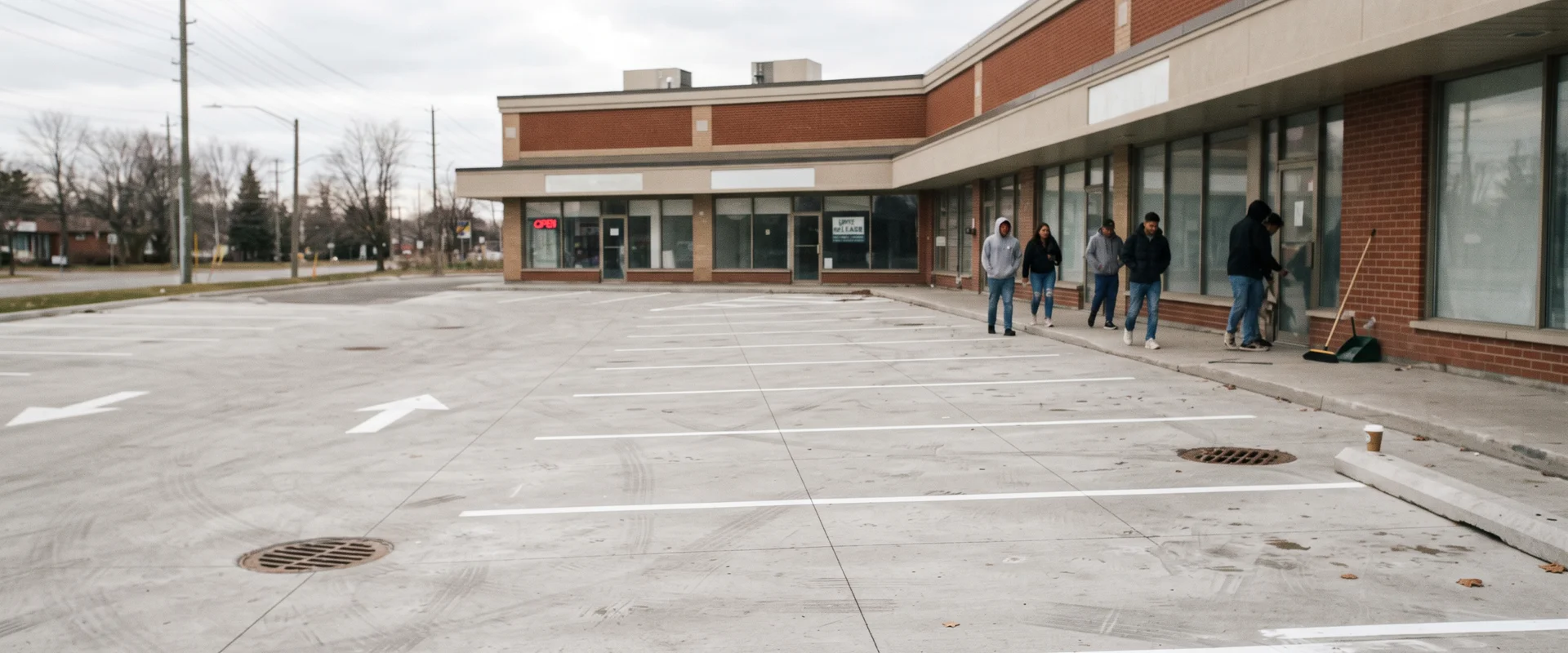
Newly poured commercial concrete parking lot with fresh line painting

Commercial Concrete Parking Lot Pours Across the GTA

Commercial, plaza and church lot pours graded for drainage and jointed for durability.

  • verified 2-Year Workmanship Warranty
  • shield WSIB + $2M Liability
  • schedule 2-Hour Quote Window
  • star 4.9 Google Rating
Published pricing $10 - $18 per sq ft
  • 4.9 Star Google Rating
  • Published Pricing
  • 2-Year Workmanship Warranty
  • WSIB + $2M Liability
  • 2-Hour Response Window
  • 24/7 Phone
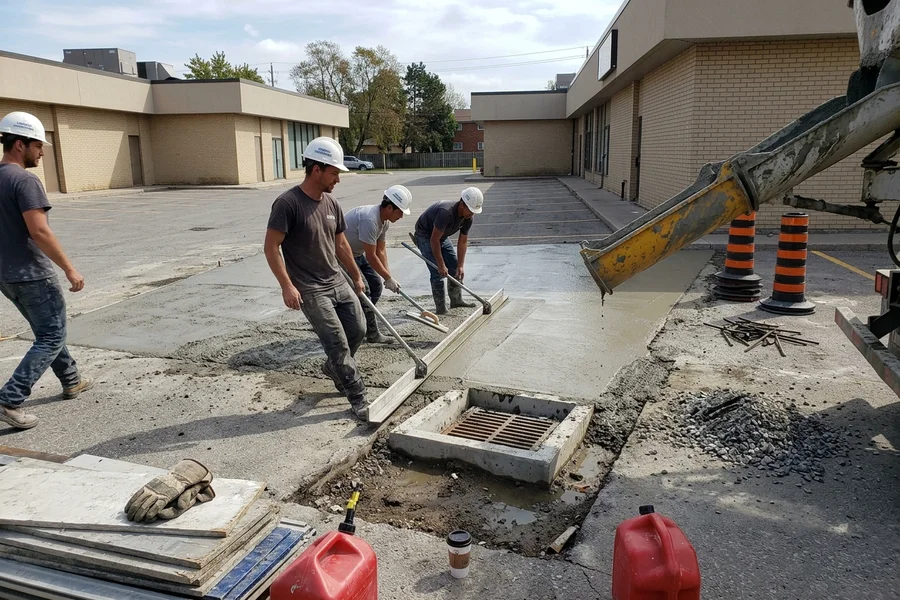
Crew screeding parking lot concrete around a catch basin at the low point

What Does a Concrete Parking Lot Involve?

A parking lot is a large area of concrete that has to shed water, carry vehicle loads, and survive a Toronto winter of freeze-thaw cycling and road salt. The three requirements interact, and drainage is the one that gets ignored most often.

We start by shooting grades and locating the existing catch basins. That determines the fall across the lot, which determines the pour sequence and the joint layout. Where the basins are undersized, badly placed, or sitting too high, we quote resetting them rather than pouring a lot that will pond every spring.

Loads come next. Passenger stall areas do fine at six inches with mesh reinforcement. Drive aisles carry every vehicle that enters, so they go to seven or eight inches with a 15M rebar grid. Truck entrances and turning areas need more again, because a turning axle grinds a far higher stress into a slab than one driving straight through.

The mix is air-entrained throughout, because a parking lot in the GTA takes direct salt from both the road and the plough for four months a year.

What’s Included

  • Grade survey and drainage design
  • Removal of the existing surface and disposal
  • Compacted granular sub-base
  • Mesh or 15M rebar reinforcement sized by zone
  • Air-entrained freeze-thaw durable mix
  • Dowelled construction joints between pour sections
  • Engineered saw-cut control joint layout
  • Catch basin work and curb transitions where required
  • Curing and hand-back ready for line painting

Common Problems We Solve

Ponding and Ice Sheets

Water that has nowhere to go becomes an ice sheet in January and a liability claim shortly afterwards. Re-grading during a replacement, with the catch basins set at the true low points, is the fix. It is also the thing most often skipped when a lot is simply resurfaced.

Rutting and Potholes in Asphalt

Asphalt softens in summer heat and deforms under heavy vehicles, particularly at entrances and bin pads. Concrete is rigid and does not rut. Converting just the drive aisle and bin pad to concrete while leaving stall areas in asphalt is a common, cost-effective compromise.

Cracked Panels Around Catch Basins

The transition from slab to basin is a stress concentration. Getting the reinforcement and joint layout right around it, rather than running the joint straight past it, is what keeps that area intact.

Salt Scaling at Entrances

Entrances take the most salt and the most traffic. Air-entrained concrete handles it, and a penetrating sealer on those specific zones extends surface life considerably.

How Much Does a Concrete Parking Lot Cost in Toronto?

Lots run $10 to $18 per square foot. The drivers:

  • Zone. Stall areas, drive aisles and truck access all get different thicknesses and reinforcement, and are priced accordingly.
  • Demolition. Removing existing asphalt or concrete and hauling it away is a real line item.
  • Drainage work. New or reset catch basins, and any storm connections, sit outside the base rate.
  • Phasing. Keeping the lot partly open costs more than a single clear pour.
  • Curbs and transitions. Curb work, sidewalk transitions and accessible parking details are quoted separately.

Concrete Versus Asphalt on Lifecycle Cost

Asphalt is cheaper to place and more expensive to own. A typical GTA asphalt lot needs crack sealing every few years, sealcoating on a similar cycle, and resurfacing at twelve to twenty years. Concrete costs more at installation and then largely stops costing money: joint inspection, occasional joint filling, and a penetrating sealer on the salt-heavy zones. Over a thirty-year hold, concrete generally wins, and it wins by a wide margin on drive aisles and truck routes where asphalt fails fastest.

When Should a Lot Be Replaced?

Replace when the surface has failed structurally, when the sub-base has washed out, or when drainage cannot be corrected any other way. Repair when the problem is confined to specific panels, joints, or one bad entrance. Our commercial repair service can rebuild an entrance apron or a bin pad without touching the rest of the lot, which is often all that is needed.

Send us the lot dimensions, a drainage description and your access constraints, and we will come back with a written published-rate quote and a phasing plan inside two hours.
Published pricing

How Much Does Parking Lots Cost in Toronto?

$10 - $18 per sq ft

Stall Areas

$10 - $12 / sq ft

  • Compacted granular base
  • 6-inch slab with mesh reinforcement
  • Drainage grading to existing catch basins
  • Saw-cut control joints
Get a Free Quote
Most requested

Drive Aisles

$12 - $15 / sq ft

  • Everything in stall areas
  • 7 to 8 inch slab with 15M rebar
  • Air-entrained freeze-thaw mix
  • Dowelled construction joints
Get a Free Quote

Heavy Truck Access

$15 - $18 / sq ft

  • Everything in drive aisles
  • Thickened entrance and turning areas
  • New or reset catch basins
  • Curb and sidewalk transitions
Get a Free Quote

Stall areas sit at the lower end. Drive aisles and truck entrances need extra thickness and reinforcement, which pushes toward the upper end.

Rates are published up front with no hidden fees. Final pricing depends on site conditions, thickness, reinforcement, and finish. See the full published rate card.

Why choose us

Why Choose Best Concrete Toronto for Parking Lots?

Drainage Designed First

Ponding is the number-one complaint on commercial lots. We shoot grades and plan the fall to the catch basins before quoting.

Phased to Stay Open

Most tenants cannot close a lot. We pour in sections so a working share of the stalls stays available throughout.

Concrete Outlasts Asphalt

Higher up-front cost, far lower lifecycle cost. No annual crack sealing, no summer rutting, no three-year resurfacing cycle.

WSIB and $2M Liability

Full documentation to your property management team before we mobilise.

Our process

How Does Parking Lots Work?

  1. 1

    Survey & Drainage Plan

    We shoot grades, locate catch basins, and plan the fall before anything else is decided.

  2. 2

    Written Quote

    Published per-square-foot pricing in writing inside our 2-hour response window, phased if the lot must stay partly open.

  3. 3

    Prep & Pour

    Remove existing surface, compact the base, set reinforcement and dowels, then place and finish in sections.

  4. 4

    Joint, Cure & Line

    Saw-cut joints on the engineered layout, cure, then hand back for line painting.

Our work

Parking Lots Projects Across the GTA

Click any image to enlarge.

How Best Concrete Toronto Compares

Factor Typical Contractor Best Concrete Toronto
Surface life Asphalt, 12 to 20 years with resurfacing Concrete, 30 years or more
Annual maintenance Crack sealing and sealcoating Joint inspection only
Summer rutting Softens under heavy vehicles Rigid, no rutting
Quote turnaround 5 to 10 business days 2-hour response window
Testimonials

What Customers Say About Our Parking Lots Work

4.9 out of 5 across Google reviews

"They phased the pour so we never lost the whole lot. Communication was straight and the schedule held."
James T. Mississauga
"Water used to pool right at the entrance every spring. They re-graded it properly and that problem is gone."
Anthony V. Agincourt
"Clear published pricing and paperwork our property manager could file the same day."
Steven C. Bayview Hill
Common questions

Parking Lots FAQs

How much does a concrete parking lot cost in Toronto?

Concrete parking lots run $10 to $18 per sq ft. Stall areas sit at the lower end, while drive aisles and truck entrances need extra thickness and reinforcement and sit toward the top.

Is concrete better than asphalt for a parking lot?

Concrete costs more up front and less over its life. It lasts 30 years or more against 12 to 20 for asphalt with resurfacing, does not rut in summer heat under heavy vehicles, and needs no sealcoating cycle. For high-traffic entrances and truck routes it is usually the cheaper long-term choice.

Can you pour a lot in sections so we stay open?

Yes, and most of our commercial lots are done that way. We phase the pour so a working share of stalls stays available, and we sequence around your peak hours.

How thick should a parking lot slab be?

Six inches with mesh is typical for passenger stall areas. Drive aisles go to seven or eight inches with 15M rebar. Truck entrances and turning areas need more again, because turning loads are far harder on a slab than straight-line driving.

How do you handle drainage?

We shoot existing grades, locate the catch basins, and design the fall before pricing the work. Where basins are undersized or in the wrong place we quote new or reset ones rather than pouring a lot that ponds.

How long before vehicles can use the new lot?

Passenger vehicles after about seven days. Heavy trucks at 28 days when the slab reaches design strength. Sections cure independently, so a phased lot returns to use section by section.

Do you handle line painting?

We hand back a cured, clean surface ready for line painting and coordinate the timing with your line marking contractor. Painting too soon on green concrete causes adhesion problems.

Do concrete lots need sealing?

A penetrating sealer on entrances and high-salt areas extends surface life against chloride. It is far less maintenance than an asphalt sealcoating cycle, and we advise a reseal every three to five years on the worst-exposed areas only.

Will you provide insurance documents before starting?

Yes. WSIB clearance and our $2M general liability certificate go to your property management team before mobilisation.

Still have questions?

We answer the phone 24/7 and reply to quote requests inside two hours.

Get a Free Quote
2-hour response window, 24/7 phone answering

Ready to Book Parking Lots?

Published pricing on parking lot concrete, a written quote inside two hours, and a 2-year workmanship warranty.

  • check_circle 2-year workmanship warranty
  • check_circle No hidden fees
  • check_circle WSIB insured, $2M liability
call