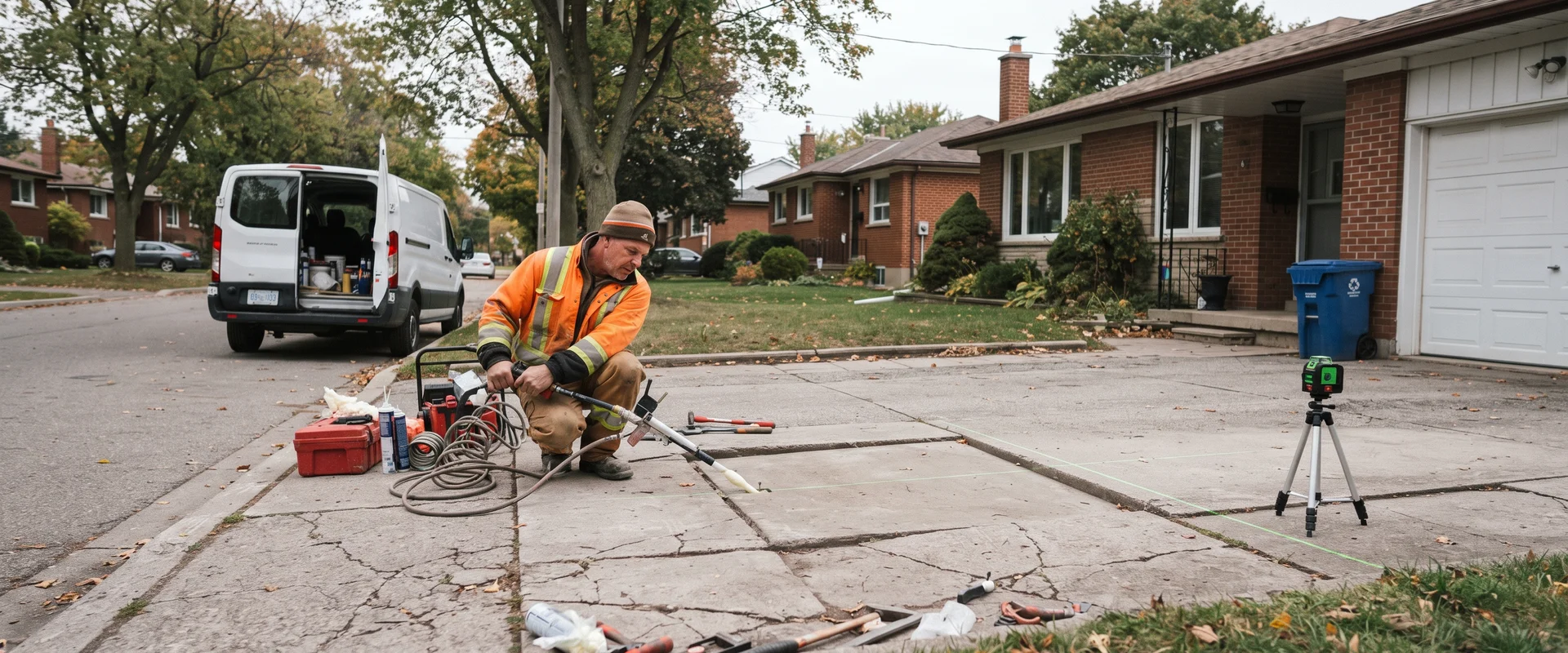
Technician injecting polyurethane foam to lift a sunken driveway slab with a laser level set up
Same-Day Fix

Concrete Lifting & Slab Levelling for Sunken Concrete in the GTA

Mudjacking and polyurethane foam lifting that raises sunken slabs without excavation.

  • verified 2-Year Workmanship Warranty
  • shield WSIB + $2M Liability
  • schedule 2-Hour Quote Window
  • star 4.9 Google Rating
Published pricing $6 - $12 per sq ft
  • 4.9 Star Google Rating
  • Published Pricing
  • 2-Year Workmanship Warranty
  • WSIB + $2M Liability
  • 2-Hour Response Window
  • 24/7 Phone
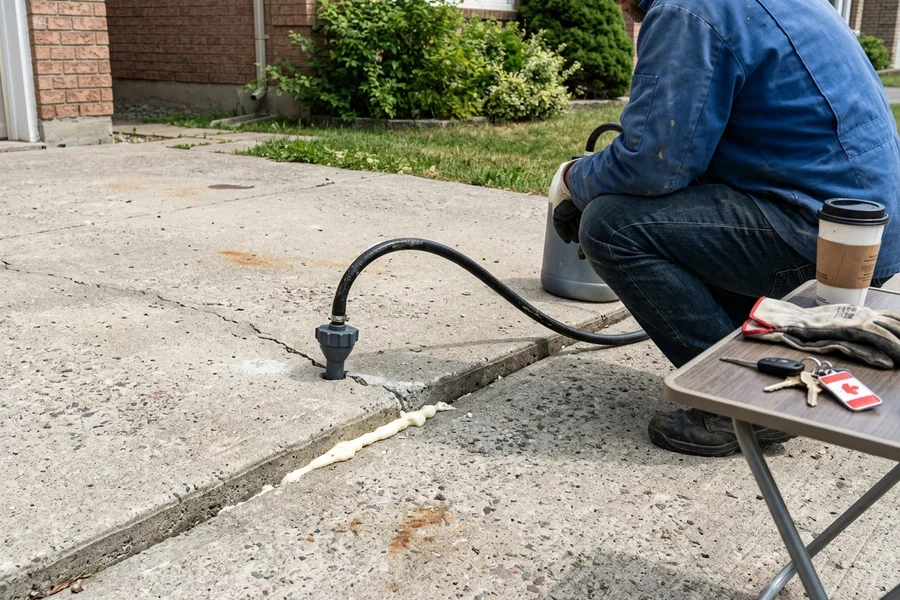
Small injection port in a concrete slab with the hose connected as the slab rises to grade

What Is Concrete Lifting?

Concrete lifting raises a sunken slab back to its original level without removing it. Small ports are drilled through the concrete, expanding polyurethane foam is injected underneath, and the slab rises in controlled stages while we watch it against a laser level. The ports are patched, the joints are resealed, and the surface goes straight back into use.

The insight that makes this work is simple: in most cases the concrete is fine. It sank because the ground under it moved, not because the slab failed. Toronto clay shrinks as it dries and leaves voids. Trench backfill over a service line settles. Water from a downspout washes fines out from underneath. Engineered fill in newer subdivisions keeps consolidating for years. In every one of those situations you have perfectly good concrete sitting on nothing.

Replacing that concrete costs $10 to $16 per square foot, takes days, and involves demolition, disposal, curing and disruption. Lifting it costs $6 to $12 per square foot and is done in hours.

We use polyurethane foam rather than traditional mudjacking for most GTA work. Mudjacking pumps a heavy cement slurry into the void, which is effective but adds considerable weight to a subgrade that has already proven it cannot carry what is on it. Foam weighs a small fraction of that, expands to fill irregular voids completely, cures in minutes, and needs ports about the diameter of a pen rather than the large holes slurry requires.

What’s Included

  • Void mapping and cause diagnosis
  • Port drilling on an engineered pattern
  • Polyurethane foam injection, or mudjacking where preferred
  • Laser-level monitoring throughout the lift
  • Controlled staged raising to avoid over-lifting
  • Sub-base stabilisation where soils are weak
  • Port patching flush with the surface
  • Joint cleaning and resealing
  • Post-lift drainage check

Common Problems We Solve

Sunken Driveways at the Garage or Sidewalk

The two places driveways drop most, because both are transitions where compaction is hardest to achieve. Lifting restores grade and stops meltwater running toward the garage or the house.

Trip Hazards on Walkways

A walkway panel that has dropped an inch is a genuine liability. Lifting it is faster and cheaper than replacement, and does not leave a new panel that does not match the weathered ones beside it.

Settled Garage and Basement Floors

Interior slabs are the strongest case for lifting, because the alternative is breaking out and repouring inside a finished building. Higher-density foam handles the load.

Pool Deck and Patio Settlement

Backfill around a pool is rarely compacted as well as the rest of the yard, so deck sections settle. Lifting avoids running a jackhammer next to a vinyl liner.

How Much Does Lifting Cost in Toronto?

Lifting runs $6 to $12 per square foot. Drivers:

  • Area. Mobilisation is a fixed cost, so small isolated lifts cost more per square foot than large ones.
  • Lift height. Raising a slab three inches uses considerably more material than raising it half an inch.
  • Void volume. Large voids under a slab take more foam than tight ones.
  • Slab type. Load-bearing interior and garage slabs need higher-density foam.
  • Access. Interior work needs more protection and clean-up than an open driveway.

Against replacement at $10 to $16 per square foot plus demolition, disposal and a week of curing, the arithmetic usually favours lifting comfortably.

When Lifting Is Not the Answer

Lifting restores level. It does not repair concrete. If the slab has broken into multiple pieces, if the surface has scaled deeply enough to expose aggregate across most of its area, or if cracking runs through with vertical displacement in several places, then raising it simply gives you level bad concrete. In those cases replacement is the honest recommendation and we will say so, and the job moves to a new concrete driveway, concrete walkway or concrete patio depending on the surface. Isolated cracks in an otherwise sound slab are handled separately under concrete crack repair, and a lifted slab with a tired surface can be finished with concrete resurfacing.

We also look for the cause. A slab that sank because a downspout has been discharging against the foundation for five years will sink again if the downspout is not addressed. Fixing the symptom without mentioning the cause is not a service we are interested in providing.

Send us a photo showing the drop, ideally with a straight edge across the joint, and we will come back with a written published-rate quote inside two hours.
Published pricing

How Much Does Lifting & Levelling Cost in Toronto?

$6 - $12 per sq ft

Walkway & Step Lift

$6 - $8 / sq ft

  • Void mapping and port drilling
  • Polyurethane foam injection
  • Laser-level monitoring
  • Ports patched, same-day use
Get a Free Quote
Most requested

Driveway Lift

$8 - $10 / sq ft

  • Everything in the walkway lift
  • Multi-panel sequencing to hold grade
  • Joint cleaning and resealing
  • Drainage check after levelling
Get a Free Quote

Garage & Structural Slab

$10 - $12 / sq ft

  • Everything in the driveway lift
  • Higher density foam for load-bearing slabs
  • Sub-base stabilisation injection
  • Post-lift level verification report
Get a Free Quote

Small isolated lifts sit at the upper end per square foot because mobilisation is a fixed cost. Larger areas are cheaper per foot. Compare against $10 to $16 per sq ft for full replacement.

Rates are published up front with no hidden fees. Final pricing depends on site conditions, thickness, reinforcement, and finish. See the full published rate card.

Why choose us

Why Choose Best Concrete Toronto for Lifting & Levelling?

Foam Suits Toronto Clay

Polyurethane foam weighs a fraction of mudjacking slurry. On soft clay subgrades, heavy slurry can settle again. Foam does not add the load that caused the problem.

Same-Day Return to Service

Foam cures in minutes. Most driveways and walkways are lifted and back in use within a single visit.

No Excavation, No Mess

Ports are small and patched flush. There is no digging, no disposal and no landscaping damage.

Half the Cost of Replacement

$6 to $12 per sq ft against $10 to $16 for a new driveway, with no demolition or curing time.

Our process

How Does Lifting & Levelling Work?

  1. 1

    Map the Voids

    We identify where the slab has lost support and set the port pattern to fill those voids evenly.

  2. 2

    Written Quote

    Published per-square-foot pricing in writing inside our 2-hour response window.

  3. 3

    Inject & Lift

    Drill small ports, inject expanding polyurethane, and raise the slab in controlled stages against a laser level.

  4. 4

    Patch & Return

    Patch the ports, clean and reseal the joints, and hand the surface straight back to use.

Our work

Lifting & Levelling Projects Across the GTA

Click any image to enlarge.

How Best Concrete Toronto Compares

Factor Typical Contractor Best Concrete Toronto
Excavation required Full removal and replacement None, small injection ports only
Return to service 7 days after replacement Same day
Material weight on subgrade Mudjacking slurry is heavy Polyurethane foam is lightweight
Cost per sq ft $10 to $16 replacement $6 to $12 lifting
Testimonials

What Customers Say About Our Lifting & Levelling Work

4.9 out of 5 across Google reviews

"Half the contractors wanted to replace my whole driveway, but Best Concrete lifted and resurfaced it for a fraction of the price. Honest and fast."
David R. Etobicoke
"Driveway had a three-inch drop at the sidewalk. Lifted with foam in half a day, no digging, no mess. We drove on it the same evening."
Anthony V. Agincourt
"Our Springdale driveway had dropped at the garage apron. They filled the void with foam and levelled it in one visit. Far cheaper than the replacement quotes we had."
Ravi P. Springdale
Common questions

Lifting & Levelling FAQs

How much does concrete lifting cost vs replacement?

Lifting a sunken slab costs $6 to $12 per sq ft against $10 to $16 per sq ft for full replacement, and it happens in hours rather than days. When the concrete itself is sound and only the base has settled, lifting is the smart choice. If the slab is cracked through or crumbling, replacement is better value long term.

What is the difference between mudjacking and polyurethane foam lifting?

Mudjacking pumps a cement slurry under the slab to raise it. Polyurethane foam injects a lightweight expanding foam instead. Foam is far lighter, cures in minutes, needs much smaller ports, and resists re-settling in Toronto clay soil where heavy slurry can sink again. We recommend foam for most GTA jobs.

How long does slab lifting take?

Most residential driveways and walkways are lifted in half a day. Polyurethane foam cures in minutes, so you can drive or walk on the slab the same day. There is no excavation and no waiting for concrete to cure.

Will the lifted slab settle again?

Polyurethane foam fills the void and also stabilises the soil it contacts, and it does not add meaningful weight to the subgrade. Where the underlying cause is ongoing, such as a leaking downspout washing out the base, we identify it, because fixing the cause is what makes the lift permanent.

Why do Toronto slabs sink in the first place?

Clay subgrade shrinking as it dries, poorly compacted backfill over service trenches, water washing fines out from under the slab, and settlement of engineered fill in newer subdivisions. All four leave a void, the slab loses support, and it drops.

How big are the injection holes?

Foam lifting uses ports around 16 millimetres in diameter, roughly the size of a pen. Mudjacking needs considerably larger holes. Ports are patched flush at the end of the visit and are barely noticeable afterwards.

Can you lift a garage floor?

Yes. Garage slabs, basement floors and interior slabs are all liftable with higher-density foam. It is one of the least disruptive repairs available, because the alternative is breaking out and repouring an interior slab.

Can you lift a slab that is also cracked?

Often yes. We lift the panels back to level and then repair the cracks, either by injection or sealing. If the slab has broken into many small pieces, lifting will not hold it together and replacement is the honest recommendation.

Does lifting fix drainage problems?

It usually does, because most drainage problems on residential properties come from a slab that has settled and now slopes toward the house. We check fall after the lift and confirm water runs away from the building.

Still have questions?

We answer the phone 24/7 and reply to quote requests inside two hours.

Get a Free Quote

Try Our Free Repair vs Replace Savings Estimator

See roughly how much you could save by repairing concrete instead of replacing it, based on our repair-first data.

Use the Calculator arrow_forward
2-hour response window, 24/7 phone answering

Ready to Book Lifting & Levelling?

Published pricing on concrete lifting & levelling, a written quote inside two hours, and a 2-year workmanship warranty.

  • check_circle 2-year workmanship warranty
  • check_circle No hidden fees
  • check_circle WSIB insured, $2M liability
call