What Is Commercial Concrete Repair?
Most commercial floors we are called to look at do not need replacing. They need joints filled, spalls patched, and drain aprons rebuilt. Those three items account for the large majority of complaints from facility and property managers across the GTA, and all three can be done in overnight windows without stopping the operation.
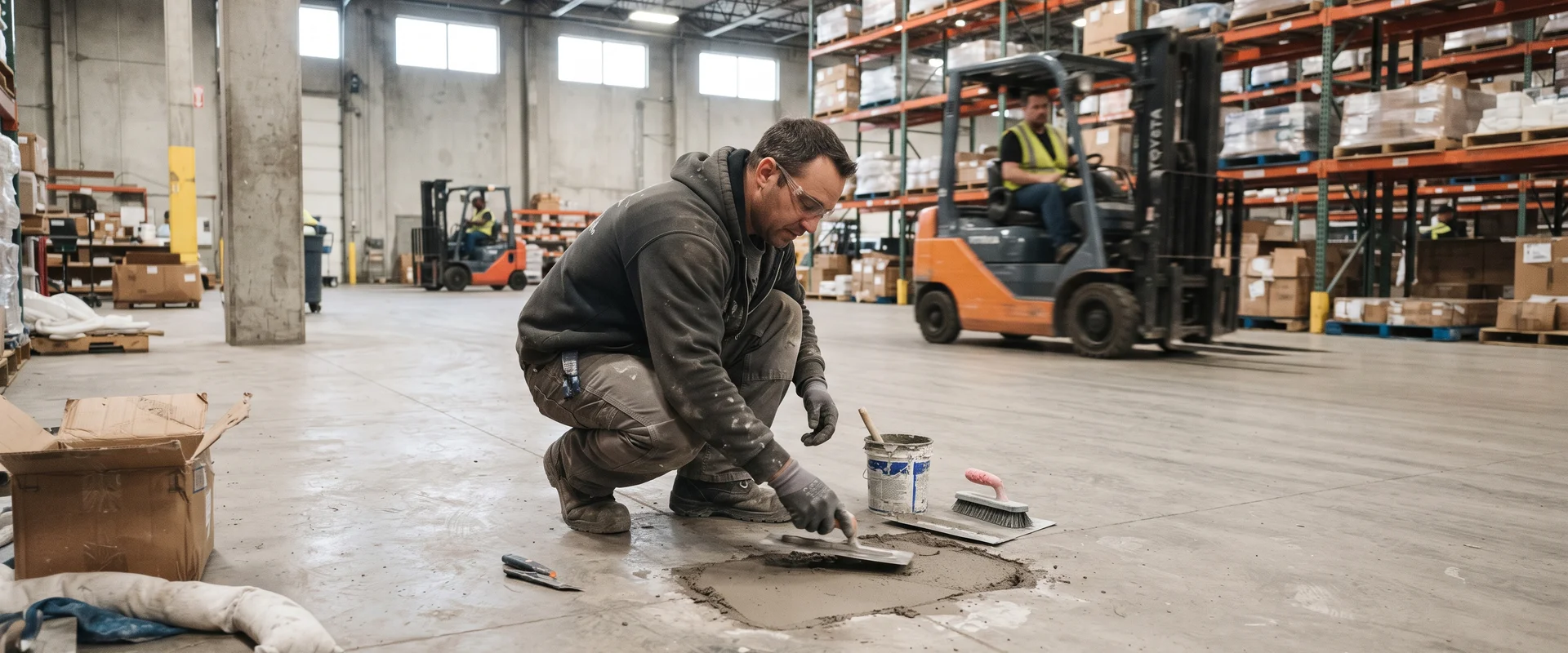
The work itself is unglamorous and entirely dependent on preparation. A patch fails at the bond line, not in the material, so we saw-cut the damaged area back to sound concrete with square edges, then shot blast or grind to a CSP-3 surface profile. Only then does the polymer-modified repair material go down, and it gets ground flush with the surrounding floor rather than left proud.
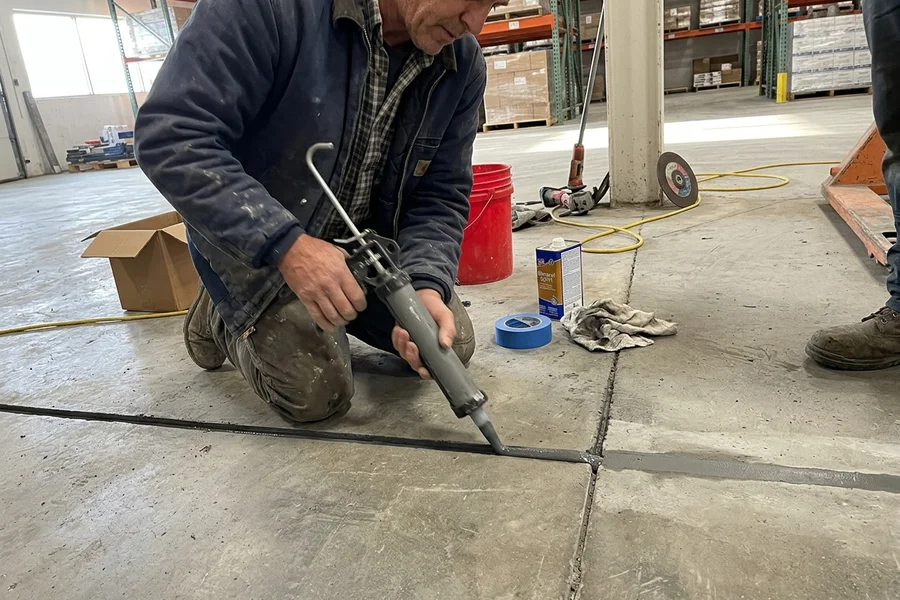
Joints get a different treatment. A saw-cut control joint in a forklift aisle is an unsupported edge on each side. Hard polyurethane wheels drop into it and hammer those edges until they break away. Filling the joint with a semi-rigid polyurea, then shaving it flush, restores edge support so the wheel rolls across instead of dropping in. Flexible caulk does not do this: it compresses under the wheel and the edges keep breaking.
What’s Included
- Floor walk-through with a marked-up repair schedule
- Saw-cutting damaged areas back to sound concrete
- Shot blasting or grinding to a CSP-3 surface profile
- Polymer-modified repair material, ground flush
- Semi-rigid polyurea joint filling, shaved flush
- Catch basin and trench drain apron rebuilds
- Full-depth panel replacement where required
- Overnight and weekend scheduling
- Clean hand-back with the area ready for traffic
Common Problems We Solve
Spalled Joint Edges
The single most common industrial floor complaint. It starts as a chip, becomes a channel, and eventually damages the forklift as much as the floor. Restoring the edges and filling the joint stops the cycle permanently in most facilities.
Surface Spalls and Pop-Outs
Isolated failures caused by a weak surface layer, an embedded contaminant, or impact damage. Each one becomes a trip hazard and a place for water and debris to collect. Cut back, prepared and patched, they disappear.
Failing Drain and Basin Aprons
The concrete immediately around a trench drain or catch basin takes wheel loading on an interrupted slab. It breaks down first and then lets water under the surrounding floor, which accelerates everything. Rebuilding the apron is a small, high-value repair.
Dusting Floors
A floor that produces fine dust under traffic has a weak surface. On a floor otherwise in good condition, grinding and a lithium-silicate densifier hardens it without a coating and without a shutdown.
How Much Does Commercial Repair Cost in Toronto?
Repairs run $8 to $15 per square foot across the repaired area, and joint filling is quoted per linear foot once measured. The drivers:
- Depth. Surface patching is far less involved than full-depth panel replacement.
- Preparation method. Shot blasting large areas costs more than grinding small ones, and both cost less than the failed patch you would otherwise redo.
- Material. High-early materials cost more per unit and buy back operating hours.
- Access window. Overnight and weekend work carries a premium against the downtime it avoids.
- Total volume. A programme of repairs across a facility is more efficient per unit than isolated call-outs.
Repair or Replace?
Repair when the slab is structurally sound and the problems are confined to joints, surface spalls, and drain aprons. That is the situation in most facilities, and the cost difference against replacement is enormous.
Replace when panels are cracked through and moving differentially under load, when the sub-base has failed and the slab is rocking, or when a new operation needs load capacity the existing floor was never designed for. We tell you which one you are looking at during the walk-through, and we mark up a plan showing what needs doing now and what can safely wait until next year’s budget.
Send us the floor area, a description of the problems and your available work windows, and we will come back with a written published-rate quote inside two hours.