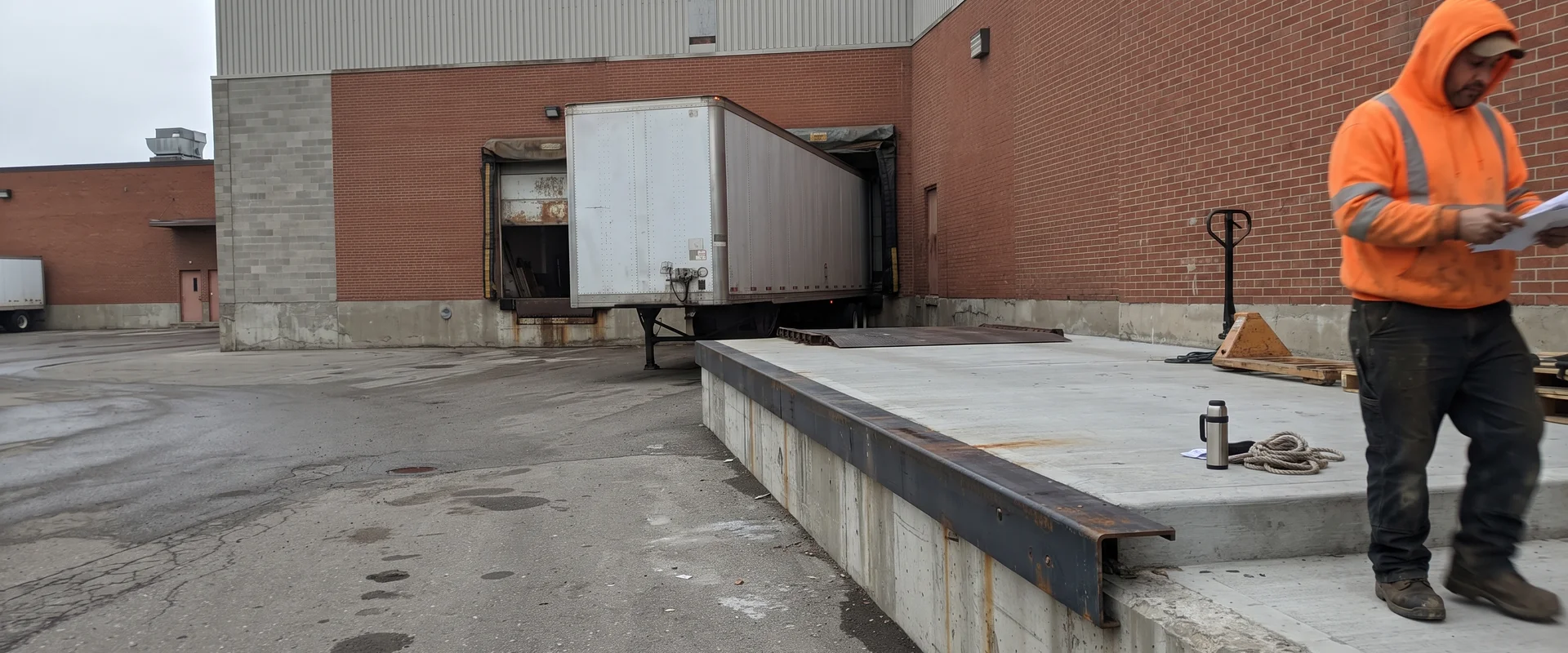
Loading dock with a new concrete pad and armoured steel edge angle at a Toronto industrial building

Loading Dock Pads & Leveller Pits, High-Load Concrete in the GTA

Dock pads, dock-leveller pits and high-load slabs built with edge armouring.

  • verified 2-Year Workmanship Warranty
  • shield WSIB + $2M Liability
  • schedule 2-Hour Quote Window
  • star 4.9 Google Rating
Published pricing $12 - $22 per sq ft
  • 4.9 Star Google Rating
  • Published Pricing
  • 2-Year Workmanship Warranty
  • WSIB + $2M Liability
  • 2-Hour Response Window
  • 24/7 Phone
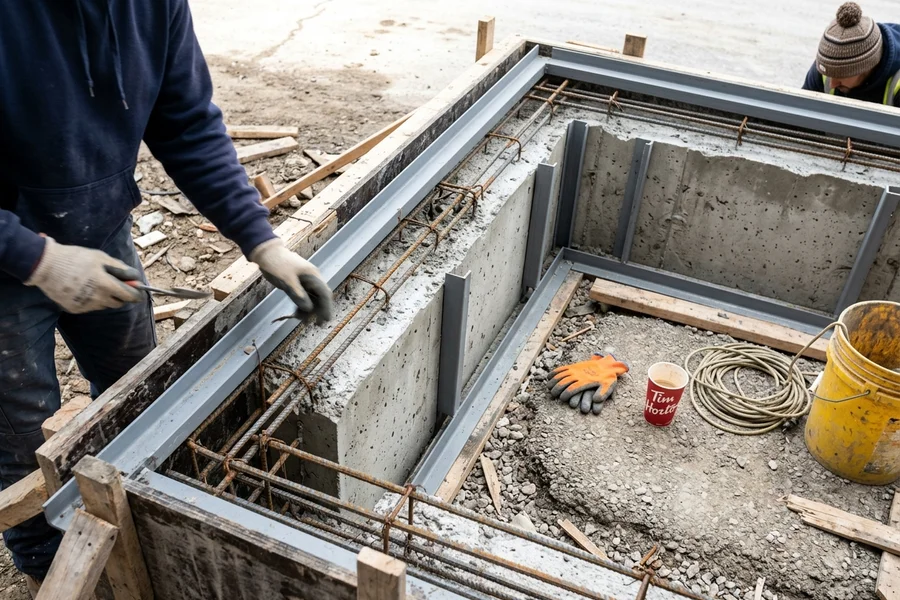
Dock leveller pit being formed with embedded steel angle and rebar cage

What Is Loading Dock Concrete Work?

A loading dock is the hardest-worked concrete on any commercial property. It takes trailer impact at a single edge, landing-gear point loads that concentrate several tonnes onto a few square inches, tractor turning that grinds the surface, and forklift traffic crossing the same threshold hundreds of times a day. Ordinary floor concrete does not survive it.

So dock work gets a different specification. Approach slabs are eight inches thick with a 15M rebar grid over a properly compacted sub-base. The mix is 35 MPa rather than the 32 MPa we use on residential driveways, chosen for impact and abrasion resistance as much as compressive strength. And the exposed dock edge gets embedded steel angle, so the trailer hits steel instead of concrete.

Leveller pits are a precision job. Each manufacturer publishes pit dimensions, anchor positions and drainage requirements for their equipment. We form to those drawings, so the unit drops in without anyone modifying the site afterwards. Send us the model number before we quote and the pit will be right the first time.

What’s Included

  • Excavation, sub-base compaction and vapour barrier
  • Rebar cage sized for impact and point loading
  • 35 MPa high-load concrete mix
  • Embedded steel angle armouring at the dock edge
  • Dowelled joints for load transfer to adjacent slabs
  • Leveller pit formed to manufacturer dimensions with anchors
  • Pit drainage tied to the site system
  • Dry-shake hardener at wheel paths
  • Bay-by-bay sequencing around your shipping schedule

Common Problems We Solve

Broken Dock Edges

The classic failure. Concrete chips at the edge, then breaks back in larger pieces, then exposes rebar. Once rebar is exposed, corrosion accelerates the damage every winter. The repair is to saw-cut the damaged strip back to sound concrete, install new embedded steel angle, and repour just that strip. That is a fraction of a full pad replacement and can usually happen overnight.

Cracked Approach Slabs

Trailer landing gear punches down through slabs that were poured to general yard specification. Where an approach slab is cracking in a repeating pattern in front of each bay, the slab was under-designed rather than badly built. Replacement with proper thickness and reinforcement is the only durable answer.

Flooded or Corroded Leveller Pits

Pits collect meltwater, road salt and debris. A pit without working drainage corrodes the leveller frame from underneath and shortens equipment life considerably. Retrofitting drainage during a pit rebuild is straightforward and protects a much more expensive piece of equipment.

Uneven Dock Height

Where an approach slab has settled, the dock face no longer matches trailer bed height and levellers run at the end of their travel. Lifting the approach slab with polyurethane foam can restore geometry without demolition, provided the concrete itself is sound.

How Much Does Dock Concrete Cost in Toronto?

Dock work runs $12 to $22 per square foot. Cost drivers:

  • Scope. An approach slab is far less involved than a full pit build.
  • Steel. Embedded angle armouring, anchors and heavier rebar all add material cost, and all pay back.
  • Excavation. Pits are deep and often hit services that need locating and protecting.
  • Drainage. New pit drainage and connections sit outside the base rate.
  • Schedule. High-early mixes and night work carry a premium against the shipping downtime they avoid.
  • Bay count. Doing several bays in one mobilisation is more efficient per bay than one at a time.

When Should a Dock Be Rebuilt Rather Than Repaired?

Repair when the slab behind the edge is sound and the damage is confined to the edge strip, isolated spalls, or joints. That covers most of what we see, it is the cheaper and faster path, and it is quoted under commercial concrete repair. Rebuild when the approach slab is cracked through and moving differentially, when the sub-base under the pad has failed, or when a new leveller requires pit geometry the existing pit cannot provide.

Dock work rarely stops at the door. The apron in front of the bays is usually poured at the same time as the parking lot, the floor inside the door is commercial concrete flooring or a warehouse slab carrying the same forklift traffic, and openings for new drainage or levellers are made with concrete cutting and coring. Where an approach slab has settled but is otherwise intact, concrete lifting and levelling restores the transition overnight.

Send us your bay count, leveller model and shipping constraints and we will come back with a written published-rate quote and a bay-by-bay sequence inside two hours.
Published pricing

How Much Does Loading Docks Cost in Toronto?

$12 - $22 per sq ft

Approach Slab

$12 - $15 / sq ft

  • Compacted sub-base and vapour barrier
  • 8-inch slab with 15M rebar
  • 35 MPa high-load mix
  • Drainage fall away from the building
Get a Free Quote
Most requested

Dock Pad with Armouring

$15 - $19 / sq ft

  • Everything in the approach slab
  • Embedded steel angle at the dock edge
  • Dowelled joints for load transfer
  • Dry-shake hardener at wheel paths
Get a Free Quote

Leveller Pit Build

$19 - $22 / sq ft

  • Everything in the armoured dock pad
  • Pit formed to the leveller manufacturer dimensions
  • Embedded anchors and pit drainage
  • High-early mix for fast return to service
Get a Free Quote

Approach slabs sit at the lower end. Dock-leveller pits with embedded steel and drainage sit at the top, and are often quoted per pit rather than per square foot.

Rates are published up front with no hidden fees. Final pricing depends on site conditions, thickness, reinforcement, and finish. See the full published rate card.

Why choose us

Why Choose Best Concrete Toronto for Loading Docks?

Edges That Survive Impact

Embedded steel angle at the dock edge takes the trailer hits so the concrete does not. It is the single detail that decides how long a dock lasts.

Pits Built to the Equipment

We form to your leveller manufacturer dimensions, so the unit drops in without site modification.

Bay-by-Bay Sequencing

One bay at a time keeps your shipping schedule intact. We plan the sequence with your operations team.

35 MPa High-Load Mixes

Dock concrete takes concentrated impact and constant forklift traffic. It gets a stronger mix than the rest of the floor.

Our process

How Does Loading Docks Work?

  1. 1

    Measure the Equipment

    Pit geometry comes from your leveller model and trailer heights, so we take those before anything is formed.

  2. 2

    Written Quote

    Published pricing in writing inside our 2-hour response window, with a bay-by-bay sequence.

  3. 3

    Form & Armour

    Excavate, tie the rebar cage, set embedded steel angle and anchors, then place the high-load mix.

  4. 4

    Cure & Recommission

    Cure, strip, verify the leveller fits, and hand the bay back to operations.

Our work

Loading Docks Projects Across the GTA

Click any image to enlarge.

How Best Concrete Toronto Compares

Factor Typical Contractor Best Concrete Toronto
Edge protection Plain concrete edge, chips under trailer impact Embedded steel angle armouring at the dock edge
Quote turnaround 2 to 5 business days 2-hour response window
Concrete strength General-purpose commercial mix 35 MPa high-load mix built for impact and abrasion
Pit accuracy Built to a generic drawing Formed to your leveller manufacturer's exact dimensions
Shipping disruption Whole dock closed for the job Bay-by-bay sequencing keeps shipping running
Testimonials

What Customers Say About Our Loading Docks Work

4.9 out of 5 across Google reviews

"One bay at a time meant we never stopped shipping. The armoured edge has taken a year of trailer hits without a chip."
James T. Mississauga
"They measured the leveller before quoting and the unit dropped straight in. No site modifications, no delay."
Curtis B. Brooklin
"Fully insured, paperwork ahead of mobilisation, and they cleaned up every night so the yard stayed usable."
Anthony V. Agincourt
Common questions

Loading Docks FAQs

How much does loading dock concrete cost in Toronto?

Dock work runs $12 to $22 per sq ft. Approach slabs sit at the lower end. Dock pads with embedded steel armouring sit in the middle, and leveller pits with anchors and drainage sit at the top.

Why do dock edges break down so quickly?

A trailer backing in delivers a concentrated impact on the exact edge of the concrete, hundreds of times a week. Unprotected concrete cannot take that indefinitely. Embedded steel angle at the edge takes the hit instead and can be replaced without touching the slab.

Can you build a pit for a specific dock leveller?

Yes. We form to the manufacturer's pit dimensions, including anchor locations and drainage, so the unit installs without site modification. Send us the model number and we will work from the published pit drawing.

How thick should a dock approach slab be?

Eight inches with a 15M rebar grid is typical, on a properly compacted sub-base. Trailer landing gear concentrates enormous load on a small footprint, and turning tractors grind at the surface, so approach slabs get more thickness and stronger concrete than general yard areas.

Can you do the work without stopping shipping?

In almost every case, yes. We sequence bay by bay so the rest of the dock keeps operating, and we can work nights and weekends where the schedule is tight.

How long before a bay returns to service?

With a standard mix, trailer traffic at 28 days. With a high-early strength mix we can bring a bay back much sooner, and we quote that option wherever downtime is the dominant cost.

What concrete strength do you use at docks?

35 MPa is our standard for dock pads and pits, higher than the 32 MPa we use on driveways and the mixes typical for general commercial floors. The extra strength is there for impact and abrasion, not just compressive load.

Do you handle pit drainage?

Yes. Leveller pits collect water and debris, and a pit that cannot drain corrodes the equipment inside it. We form in the drainage and tie it to the site system.

Do you repair existing dock edges rather than replacing them?

Frequently. If the slab behind the edge is sound, we can saw-cut the damaged edge back, install new embedded steel angle and repour just that strip. That is a fraction of the cost of a new pad and can be done overnight.

Still have questions?

We answer the phone 24/7 and reply to quote requests inside two hours.

Get a Free Quote
2-hour response window, 24/7 phone answering

Ready to Book Loading Docks?

Published pricing on loading dock concrete, a written quote inside two hours, and a 2-year workmanship warranty.

  • check_circle 2-year workmanship warranty
  • check_circle No hidden fees
  • check_circle WSIB insured, $2M liability
call