What Is Concrete Foundation Repair?
Foundation repair covers four related jobs: sealing cracks so water stops coming through, stabilising walls that are moving, restoring concrete that road salt has eaten away above grade, and managing the water outside that caused most of it in the first place.
Which of those you need depends entirely on diagnosis, and diagnosis is where this trade earns or loses its reputation. A leaking crack can be sealed from inside in a few hours for a few hundred dollars. The same leak, if the real problem is a blocked weeping tile and hydrostatic pressure against the whole wall, will come back somewhere else next spring. So before quoting we look outside as well as inside: grading, downspout discharge, window wells and the general water path around the house.
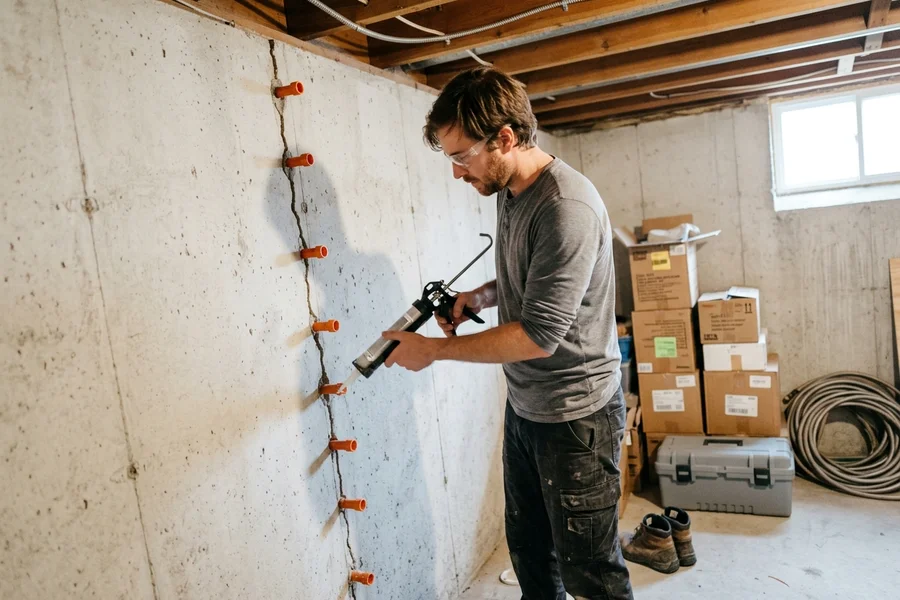
Interior work uses hydrophobic polyurethane injected through surface-mounted ports. It reacts with the water already in the crack and expands to fill the full wall thickness. For dry structural cracks we use epoxy instead, which bonds the concrete back into one piece. Where a crack is still moving, carbon-fibre stitching bonded across it stops the movement, which is the only way any filler survives long term.
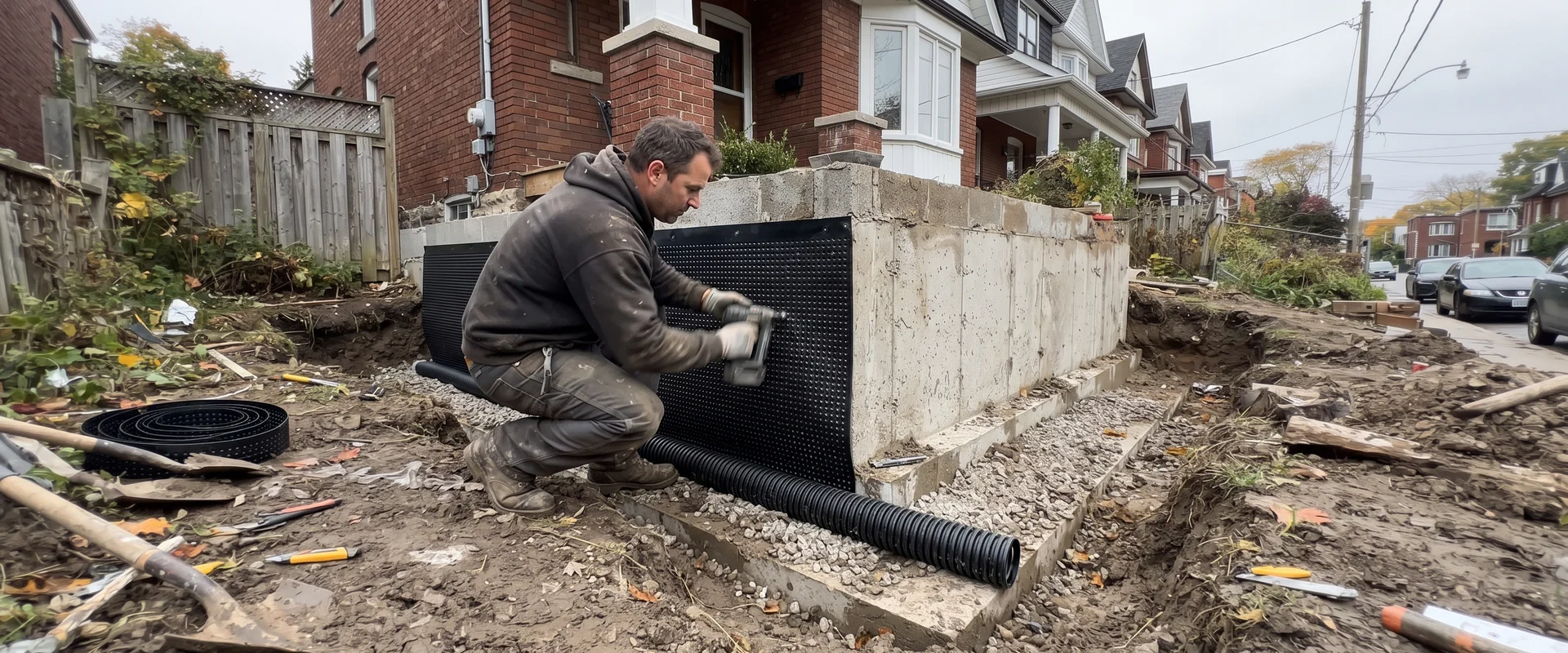
Exterior work means excavating to footing depth, cleaning the wall, sealing it, installing a Delta-MS style dimple membrane, inspecting and tying in the weeping tile, then backfilling and restoring grade. It is expensive and disruptive, and we recommend it when it is genuinely warranted rather than as a default.
What’s Included
- Interior and exterior water-path diagnosis
- Crack mapping and movement assessment
- Hydrophobic polyurethane or epoxy injection
- Carbon-fibre stitching on moving cracks and bowing walls
- Polymer-modified parging on spalled above-grade walls
- Excavation to footing depth where exterior work is needed
- Dimple membrane installation and drainage tie-in
- Weeping tile inspection, flushing or replacement
- Backfill, grading and site restoration
Common Problems We Solve
Water on the Basement Floor After Heavy Rain
Almost always traceable to a specific crack or a specific entry point. Injection seals it. We also check the outside, because a downspout discharging against the wall will overwhelm any repair eventually.
Horizontal Cracks and Bowing Walls
More serious than vertical cracks, and usually caused by lateral soil pressure, often made worse by clay expansion and frost. Carbon-fibre stitching resists further movement without steel beams intruding into the room. Severe cases need engineered intervention, and we say so.
Spalling Above-Grade Foundation Walls
The exposed strip of foundation between the grade and the siding takes direct road salt every winter. It flakes, then crumbles, then exposes aggregate. Polymer-modified parging restores it and protects what is behind.
Efflorescence and Damp Walls
The white powdery deposit on a basement wall is free lime carried out by moisture moving through the concrete. It is a symptom of water movement, not a defect in itself, and it tells us where to look.
How Much Does Foundation Repair Cost in Toronto?
Foundation work is priced per crack at $300 to $2,500, with severity driving the range. Cost drivers:
- Interior versus exterior. Excavation multiplies the cost of any repair.
- Depth and access. Deep foundations, tight side yards and landscaping all add to excavation cost.
- Structural work. Carbon-fibre stitching adds material and labour.
- Drainage. Weeping tile replacement and drainage connections are separate items.
- Above-grade restoration. Parging is priced by area.
- Number of cracks. Several treated in one visit costs less per crack.
Interior or Exterior Repair?
Choose interior injection when there is one clearly identified leaking crack, when the wall is otherwise sound, and when exterior water management is basically adequate. It is faster, cheaper and far less disruptive, and it is quoted as concrete crack repair at the per-crack rate.
Choose exterior excavation and membrane when there are multiple failure points along a wall, when the weeping tile is blocked or absent, when the exterior face of the wall is deteriorating, when the water table or drainage is genuinely the problem, or when interior repair has already been tried and the water came back.
Anyone who quotes the same solution for every basement is not diagnosing. We will give you the interior option when it will work, and we will tell you plainly when it will not.
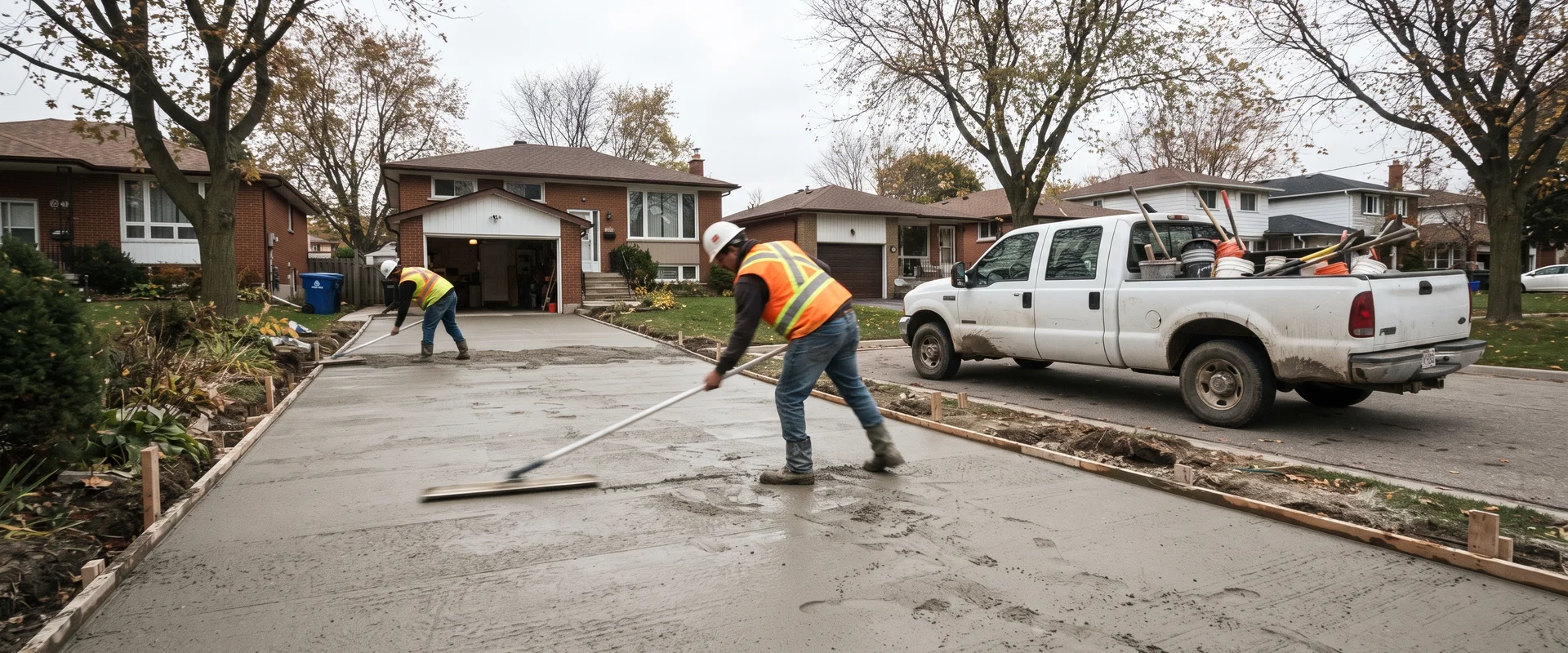
Foundation work rarely arrives alone. Once the wall is sound we re-seal the exterior face under concrete sealing and waterproofing, raise any slab that dropped while the soil was moving with concrete lifting and levelling, and rebuild the porch and front steps where excavation has disturbed them. Where the grade itself is the problem, a poured concrete retaining wall holds it back permanently.
Send photos of the crack from inside and of the grading and downspouts outside, and we will come back with a written published-rate quote inside two hours.