What Is Concrete Crack Repair?
Crack repair is where our repair-first philosophy actually gets tested. Almost every crack we look at has a cheaper answer than replacement, but only if it is diagnosed correctly first. The four methods available do completely different jobs, and using the wrong one is the reason so many homeowners have had the same crack “repaired” twice.
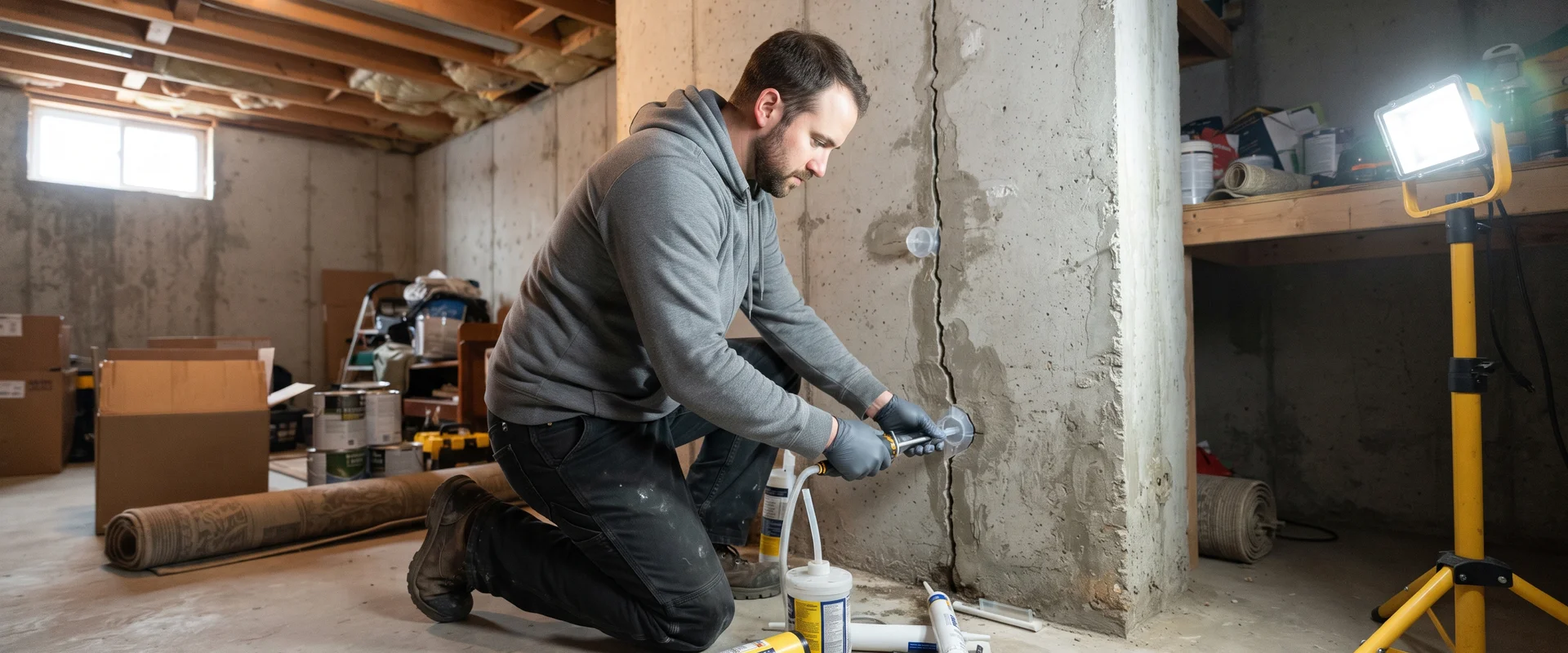
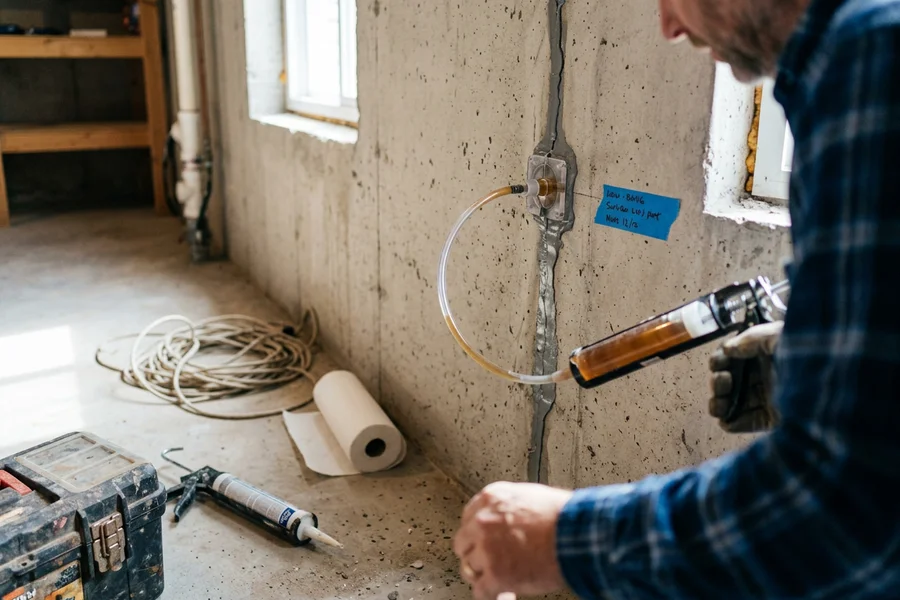
Epoxy injection is structural. A low-viscosity resin such as Sikadur is injected through surface-mounted ports into a dry crack, filling it to full depth and bonding the two faces back into one piece of concrete. Properly done, the repaired crack is stronger than the surrounding concrete.
Hydrophobic polyurethane injection is for water. It reacts with moisture, expands into the crack and seals it. Epoxy cannot cure properly in a wet crack, so an actively leaking foundation wall gets polyurethane, not epoxy, regardless of whether the crack is also structural.
Carbon-fibre stitching is for movement. Strips of high-tensile fabric are bonded perpendicular across the crack so the two sides can no longer separate. If a crack is still active, this step is not optional: fill it without stitching and it cracks again along the same line.
Cosmetic sealing is for stable hairline cracks. Routing and filling them with a flexible or semi-rigid sealant keeps water and chloride out, which is what stops a hairline crack becoming a structural one over five winters.
What’s Included
- Crack diagnosis: structural or shrinkage, active or static, wet or dry
- Crack cleaning, routing and surface preparation
- Surface seal and injection port installation
- Low-viscosity epoxy or hydrophobic polyurethane injection to refusal
- Carbon-fibre stitching where movement is present
- Port removal, grinding flush and surface patching
- Colour-matched finish on visible surfaces
- Advice on monitoring and preventing recurrence
Common Problems We Solve
Cracks Growing Wider Each Winter
Water gets into a hairline crack, freezes, expands, and widens it a fraction of a millimetre. Repeat that a hundred times a winter for a decade and a hairline becomes a structural problem. Sealing early is the cheapest intervention in concrete repair, and keeping the whole slab under a penetrating sealer is what stops the next crack starting.
Rust Staining Along a Crack Line
That means chloride from road salt has reached embedded rebar and it is corroding. Corroding steel expands to several times its original volume and splits the concrete from inside. The crack is a symptom, and the repair has to address the rebar as well as the concrete.
Leaking Foundation Cracks
Water appearing on a basement wall after heavy rain almost always traces to a specific crack. Polyurethane injection seals it from inside. Where the underlying cause is exterior water pressure or a blocked weeping tile, we say so, because sealing from inside alone treats a symptom, and that work belongs under concrete foundation repair rather than a single injection.
Cracks That Keep Coming Back
Almost always a moving crack that was filled but never stitched. Carbon fibre stops the movement. Without it, the best filler in the world simply becomes a new crack in the same place.
How Much Does Crack Repair Cost in Toronto?
Repairs are priced per crack at $200 to $600. Drivers:
- Method. Cosmetic sealing is cheapest, structural stitching most involved.
- Length and width. Long cracks need more ports and more material.
- Access. A crack in an open driveway is easier to work on than one behind finished basement framing.
- Wet or dry. Active leaks need polyurethane and often need staged injection.
- Quantity. Several cracks on one visit are considerably cheaper per crack than separate call-outs.
Repair or Replace?
This is the question that saves Toronto homeowners the most money, and the answer is repair more often than the industry admits. About half the slabs we are called out to replace can be repaired at roughly 40 percent of the cost.
Repair when cracks are isolated, when the slab is otherwise sound, when there is no widespread surface scaling, and when the base has not failed. Where the concrete itself is fine but the slab has settled, concrete lifting and levelling is usually the cheaper fix, and a worn but structurally sound surface can be renewed with concrete resurfacing. Replace when cracking runs through multiple panels with vertical displacement, when the slab rocks under load, when the surface has scaled across most of its area, or when the sub-base has washed out and lifting would only be temporary, which usually means a new concrete driveway.
We assess it on site and tell you plainly. If replacement really is the right call, we will say that too, because a repair that fails in a year costs everybody more than an honest answer on day one.
Send us a photo with something for scale next to the crack and we will come back with a written published-rate quote inside two hours.